A Bloomingdale Summer Sunday, Mapped From the Corner of 1st and R
July 16, 2026
July 16, 2026
Ask a visitor what Bloomingdale is and you will hear a version of the same sentence: Victorian rowhouses, a couple of good restaurants, brunch. Ask someone who lives on V Street or Randolph Place and the answer is different. They will describe a route. It starts at a specific corner, at a specific hour, and it explains why the neighborhood feels denser on a Sunday in July than the map suggests.
The corner is 1st and R. The hour is nine. Everything else in a Bloomingdale summer weekend arranges itself around that fact, and the openings of the last eighteen months have quietly tightened the loop so that almost nothing on a good Sunday requires a car.
The Bloomingdale Farmers' Market runs Sundays from 9 a.m. to 1 p.m. at 102 R Street NW, in front of Big Bear Cafe, and it operates year-round rather than by season. That distinction matters more than it sounds. Because BFM never closes, the block treats it as fixed infrastructure rather than a summer event, and the businesses within a short walk have organized their weekend hours around a customer who is already outside by ten.
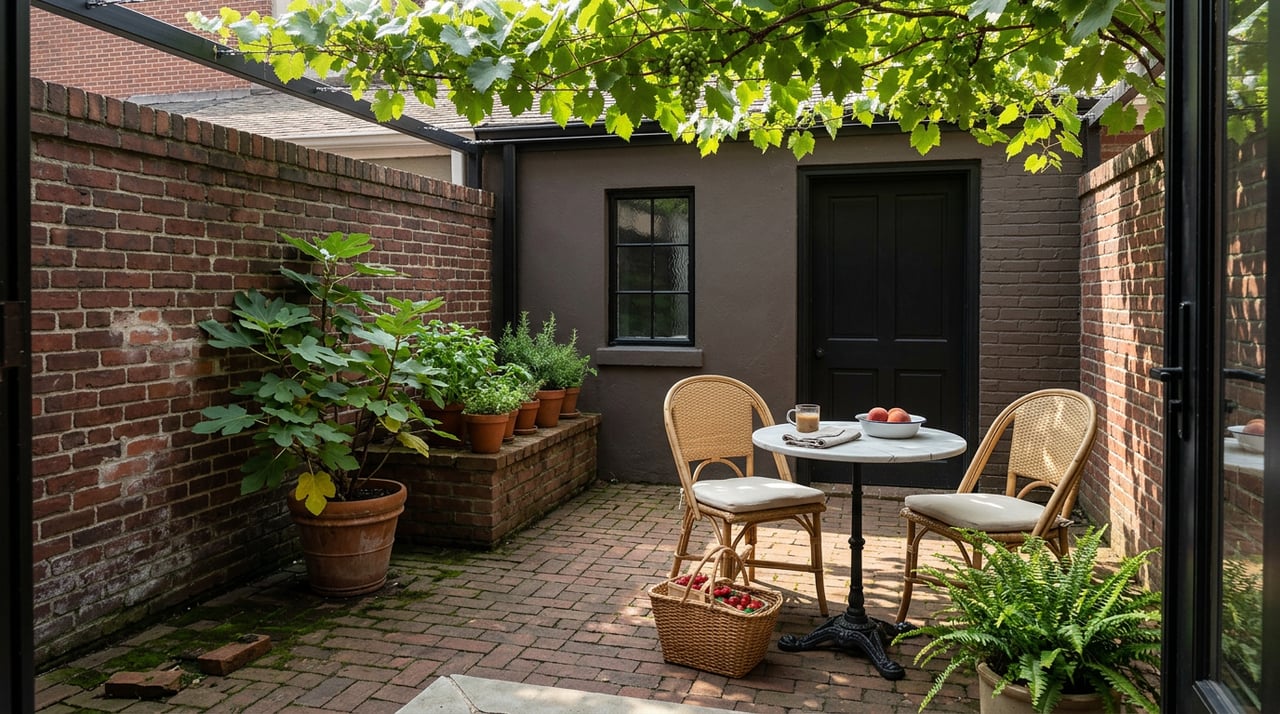
Big Bear itself, at 1700 1st Street NW, is the anchor. The cafe helped establish the market and now pours Ceremony Roasters coffee alongside wood-fired bagels and pastries during market hours. Its garden patio, wrapped in old grape vines and fruit trees, is the reason a coffee run in July turns into two hours. That is the neighborhood's opening move, and it hasn't changed in more than a decade. What has changed is what surrounds it.
The interesting story about Bloomingdale in 2026 is not that new places have opened. Every DC neighborhood can claim that. It is that the new places opened deliberately close to the 1st and R hinge, which means a resident's Sunday radius has shrunk without shrinking the options.
Four openings, four different price points and cuisines, all reachable on foot from the market table where you bought your peaches. That is the density story, and it is the one an out-of-neighborhood roundup will miss.
Farmers markets close at one. The heat of a DC July peaks at three. This is the hour when neighborhoods without a good park lose their residents to air conditioning, and it is where Bloomingdale's geography earns its keep.
Cut down an alley between U and V Streets NW and you land at Crispus Attucks Park, a little over an acre of shade, benches, and open field tucked behind the rowhouses. It is not on any tourist itinerary, which is exactly the point. It functions as the neighborhood's back yard, and on a summer Sunday it is where the market bag gets unpacked into an actual meal.
The reason a Bloomingdale summer weekend feels longer than the clock allows is that the neighborhood puts its best public space where the tourists cannot find it, four minutes from the coffee.
For evenings, the same walking radius produces 7DrumCity, the music school and 75-person live venue that occupies two adjoining yellow rowhouses. It hosts weekly shows, open-mic nights, and Flashband showcases built around newly formed groups. A ticket usually costs less than a cocktail downtown, and the walk home takes six minutes.
For most of the last decade, Bloomingdale ran on breakfast and lunch. The clichéd advice was that you came for brunch and left for dinner elsewhere. That is no longer accurate, and the shift has come from three directions at once.
Big Bear now serves dinner Wednesday through Saturday, family-style, in the same candlelit room and garden that hosts weddings the rest of the year. The kitchen leans on herbs from its own garden and produce it buys forty feet away at BFM the next morning. That is the shortest supply chain in Ward 5.
établi handles the wine-forward evening in a way the neighborhood did not previously have. The premise, borrowed from the Latin de gustibus non est disputandum, is that taste is not something to argue with, and the room is set up to let guests wander through pours until something clicks. Boundary Stone rounds out the casual end, with a happy hour running 4 to 7 p.m., Saturday and Sunday brunch until three, and open-mic and trivia nights the rest of the week.
None of this is destination dining in the Michelin-tourism sense. That is the point. A neighborhood works when residents can eat at three different places in a week without repeating themselves and without ordering a car.
Bloomingdale does not run a summer festival the way Adams Morgan or H Street does. The programming is quieter and mostly volunteer-run, which suits the block.
Sundays through the summer, the market itself is the event, and the vendor list rotates through Garner's Produce, Reid's Orchard, Groff's Content Farm, Panorama Bakery, and Cold Country Salmon depending on the week. If you have not walked the tables in a month, the mix has changed.
Off the market, 7DrumCity's weekly shows and open-mic nights are the closest thing to a reliable summer venue, and Big Bear's patio is where private events and neighborhood dinners land. Between the two, most July Sundays can be planned without leaving a six-block square.
For a resident who wants to use the neighborhood the way it is designed to be used, the route is not complicated. It looks like this.
You will notice what this list does not include. It does not send you to Shaw for coffee, to U Street for dinner, or to the Wharf for music. The point of a Bloomingdale summer is that the neighborhood has become dense enough to keep its residents in it, and the newest openings were placed with that geometry in mind.
That density is also what shows up in a listing when it comes time to sell. The line "four-minute walk to BFM" carries weight with a buyer who already knows what BFM is, and increasingly that is the buyer looking at Bloomingdale. If you own a house here and want to talk through what the last two years of new openings have done to your block's story, or you are trying to read the neighborhood before making an offer, Vassar Broermann Group knows the corners. Reach out for a free home valuation when you are ready to put a number on it.
October 15, 2026
October 8, 2026
October 1, 2026
September 24, 2026
September 17, 2026
September 17, 2026
September 10, 2026
September 3, 2026
August 27, 2026
Get assistance in determining current property value, crafting a competitive offer, writing and negotiating a contract, and much more. Contact us today.