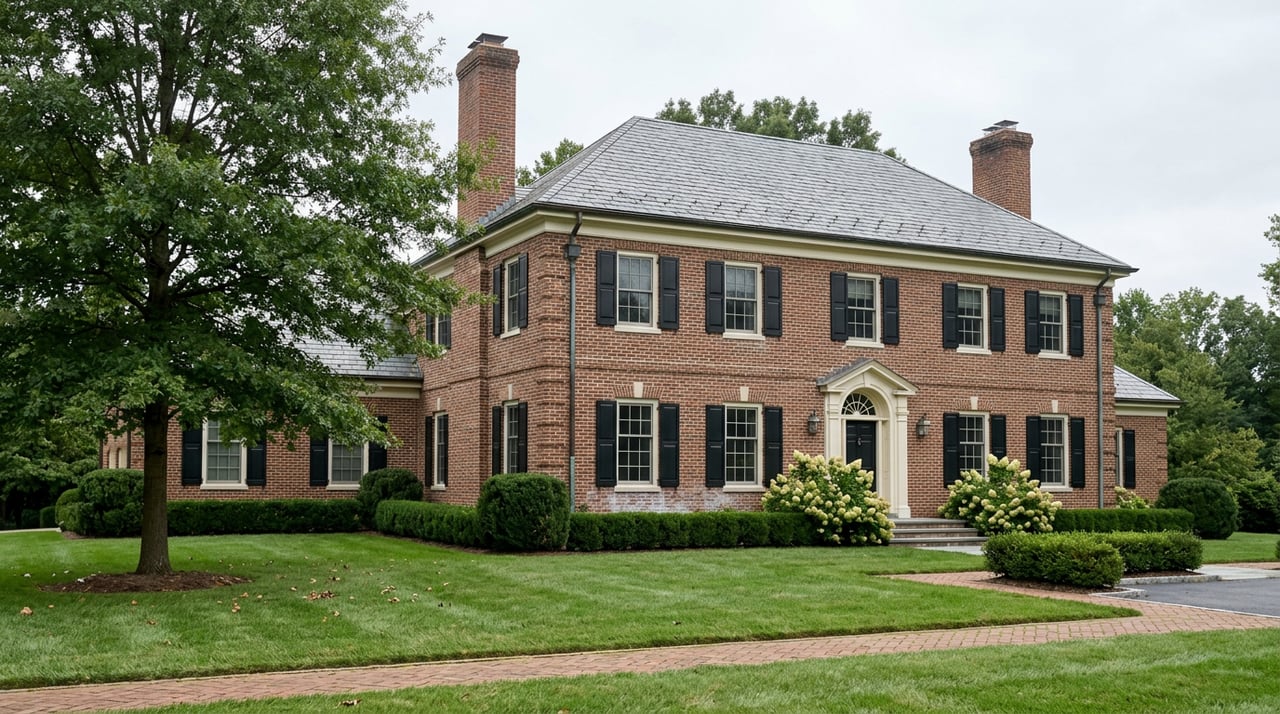
The Median Price in Great Falls Depends on Which Great Falls You Mean
September 10, 2026
September 10, 2026
A closing in Great Falls can stall for a reason that has nothing to do with financing or inspection contingencies. Virginia's standard sales contract requires the seller to hand over a septic certificate dated within 30 days of settlement, confirming there's no evidence of malfunction. If the well hasn't been tested recently, or the septic system's last pump-out predates the listing, that 30-day window becomes the thing everyone is waiting on. It's a routine snag, not a red flag, but it catches out-of-market buyers off guard almost every time, because most people shopping a $1.5 million to $2 million home assume they're hooking into the same water and sewer lines as everywhere else in Fairfax County.
Most of them are not. That single fact, more than lot size or architecture, is the real dividing line running through Great Falls real estate, and it explains something that trips up anyone comparing listings here: the median price you find depends entirely on which source you're reading, and none of them are wrong. They're describing three different housing products that happen to share a zip code.
Pull up Great Falls pricing data this fall and you'll see figures that don't obviously belong to the same market. Redfin put the median sale price at $1.9 million for the three months ending May 2026, up 23.1 percent year over year, with homes selling after 35 days on market. A separate national portal's September 2026 snapshot showed a median list price of $2.19 million at $372 per square foot, down 7 percent from both the prior month and the year before. Meanwhile, broader home-value estimates for the 22066 zip code, which blend every property type and condition rather than just recent sales, have landed closer to $1.1 million to $1.7 million depending on the methodology.
That's not a data error. It's three different slices of the same inventory. A median sale price captures whatever happened to close in a given window, which skews toward whichever segment was most active that month. A blended home-value estimate averages in older ranch-style homes on smaller parcels alongside 10,000-square-foot estates. Neither number is describing "the Great Falls market." Both are describing pieces of it.
| Segment | Typical lot | Utilities | Governance | Example areas |
|---|---|---|---|---|
| In-Village, smaller parcels | Under 1 acre | Public water and sewer common | No HOA, or standalone | Near Great Falls Village center |
| Core estate lots | 2 to 5 acres | Private well and septic | Often no HOA | Scattered throughout 22066 |
| Newer gated or estate communities | 1.7 to 5+ acres | Mixed, some public utility | HOA or private road agreement | Falcon Ridge, Falls Farm, Seneca Gate, The Reserve |
Because Great Falls zoning generally requires large minimum lot sizes, most of the community sits outside the reach of public water and sewer lines entirely. A home on a private well and septic system isn't a quirky exception here. It's the default. Fairfax County's Health Department requires septic tanks to be pumped at least once every five years under the county code, and alternative treatment systems need annual inspection by a licensed operator. Well owners are advised to test annually for bacteria and nitrates, since neither shows up in taste or smell.
None of that is disqualifying. It's simply a different due-diligence checklist than a buyer moving from a rowhouse in Arlington or a condo near Reston Town Center is used to running. Typical costs are modest on their own: a pump-out generally runs $300 to $700, an inspection $150 to $450. The number that actually changes a negotiation is a drainfield replacement, which can run into the tens of thousands depending on soil conditions, or a new well, priced anywhere from $3,000 to $15,000 depending on depth and geology.
Then there's the governance layer, which varies just as much as the utilities. Older Great Falls properties frequently carry no HOA at all, which buyers who value control over their own land tend to prefer. Newer estate communities like Falcon Ridge and Falls Farm typically do have an HOA, often specifically to maintain private roads and shared land rather than to enforce paint colors or landscaping. One property near Manning Street, Schreiner Lane, and Roos Trail carries a documented $1,200 annual voluntary maintenance agreement just to keep the private road and a bridge passable. A buyer comparing that listing against a similarly priced home with no such fee is not comparing like to like, even if both show up under the same median.
The number doesn't lie. It's just answering three different questions at once.
The variance doesn't stop at price. Days-on-market figures for Great Falls show the same split personality. One 2026 tracker put the average at roughly 28 days. Redfin's data showed 35 days over a three-month window ending in May, up slightly from 30 the year before. Sources tracking the estate and luxury segment specifically report a much wider range, roughly 40 to 75 days, with some listings stretching toward 107 days depending on price tier and how tightly the estate is positioned. Active inventory in the 22066 zip is generally described as being in the dozens rather than the hundreds at any given time.
That spread isn't inconsistency. A well-priced entry point near the Village, sitting on a smaller lot with public utilities, moves at a different speed than a multi-acre estate along a corridor like Georgetown Pike, competing against a handful of comparable listings region-wide. Both are real, current data points. Neither one describes the whole town.
If you're shopping Great Falls against a median price pulled from a portal, the more useful question isn't "is this home priced fairly compared to the average." It's "which Great Falls am I actually looking at." A smaller, in-Village lot on public water and sewer carries a different risk profile and different carrying costs than a wooded 3-acre parcel on well and septic, even if the listing prices land close together.
Before comparing two properties, it's worth confirming three things early rather than during the inspection period. First, ask whether the home is on public utilities or private well and septic, and if it's the latter, request the most recent pump-out and inspection records rather than waiting for the certificate to become a closing-week fire drill. Second, ask whether the property carries an HOA, a private road maintenance agreement, or neither, since that ongoing cost rarely shows up in the headline price. Third, confirm which Fairfax County Public Schools attendance zone applies to the specific address, since the county completed a boundary review for the 2026 to 2027 school year and assignments can shift address by address.
None of this makes Great Falls harder to buy into. It makes the shopping process more precise once you know what you're actually comparing.
Do all homes in Great Falls use well and septic systems? No, but they're common. Zoning that favors large lots means most of the 22066 zip code sits outside public water and sewer service areas, so private well and septic is the default for a large share of the housing stock. Some smaller parcels closer to Great Falls Village do have public utility connections.
Is Great Falls currently a buyer's market or a seller's market? It depends on the segment. Inventory has been described as roughly 2.5 to 4 months of supply in parts of 2026, which gives buyers more room than the ultra-tight years of 2020 to 2022, while well-priced homes in strong micro-locations still move quickly and can draw competitive offers.
Why do HOA fees vary so much between Great Falls neighborhoods? Because the HOA, where one exists, is often funded to maintain a private road, bridge, or shared land rather than amenities like a pool or clubhouse. Some estates on legacy lots carry no HOA at all, which changes the ongoing cost picture even when two homes are priced similarly.
Comparing homes in a market this segmented takes more than a portal search. If you're weighing a Great Falls property against something in McLean, Potomac, or closer to the District, the Vassar Broermann Group can walk through the utility, governance, and pricing differences specific to the address you're considering, not just the zip code average.
This article is general information, not legal, tax or financial advice. Consult a qualified professional about your situation.
October 22, 2026
October 15, 2026
October 8, 2026
October 1, 2026
September 24, 2026
September 17, 2026
September 17, 2026
September 10, 2026
September 3, 2026
Get assistance in determining current property value, crafting a competitive offer, writing and negotiating a contract, and much more. Contact us today.